Compare dedicated bulk button feeding, suitable flexible feeding and manual or tray presentation using the real button range, cosmetic limits and downstream pickup.
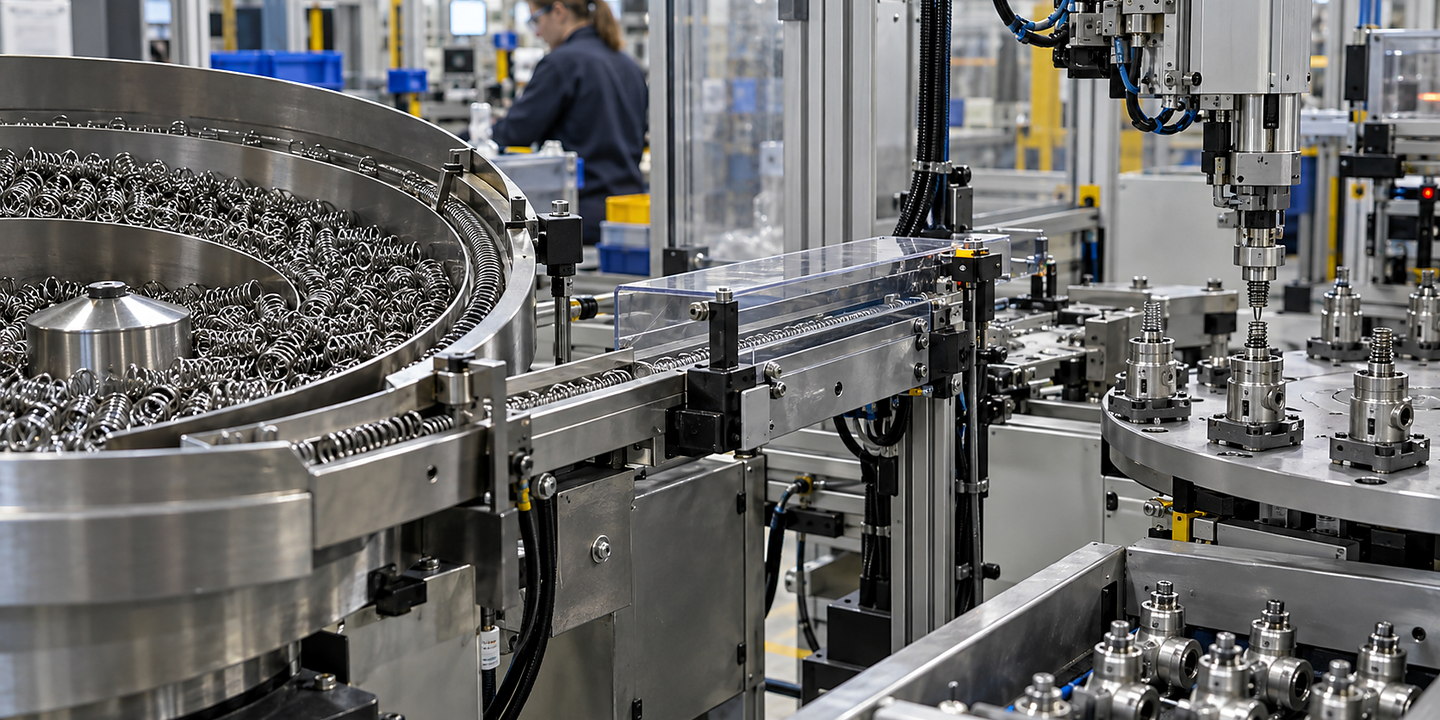
Photographs show general component feeding, including coil springs. Button feeding must be assessed with the actual button range and required pick-up condition.
In brief
Compare the presentation routes using the actual flat and shank button range, required pickup condition and acceptable cosmetic finish. Trial bulk separation against an appropriate tray or flexible route when format variation or surface sensitivity makes dedicated tooling difficult to justify.
Plan button feeding systems around real component variation, bulk condition, orientation, usable delivery rate and the downstream interface. Discuss representative part trials with Sorting Solutions.
On the production floor
See how the complete system fits your production line — Button Feeding Systems
Plan button feeding systems around real component variation, bulk condition, orientation, usable delivery rate and the downstream interface. Discuss representative part trials with Sorting Solutions. When you compare solutions, check how each option handles component geometry and variation for button orientation & automatic feeding, surface, fragility and entanglement behaviour and your surrounding line.
Button Feeding Systems support from first review to production use
Understand your requirement
Review component geometry and variation for button orientation & automatic feeding, surface, fragility and entanglement behaviour, and bulk condition and replenishment method using your samples, drawings and production observations.
Compare suitable approaches
Run focused trials for button feeding systems so you can see why an option is recommended or ruled out.
Fit the complete line
Resolve required orientation and delivery rate, escapement and downstream pick interface, controls, safety, operator access and maintenance before site work.
Prove and support the result
Check jam, damage and recovery acceptance checks in normal, difficult and fault conditions, then agree training and support for your team.
Typical support: sample assessment, feeding trials, orientation tooling, controls, escapement and line integration.
Compare your options
Compare button feeding systems with simpler routes
Approach
Often suitable when
Watch for
Button Feeding Systems
A stable button family and clear orientation features justify part-specific tooling.
Sample trials must include normal, marginal and supplier-variant components.
Flexible Vision-Guided Feeding for Suitable Variable Part Families
Variable button families merit a suitable flexible route after sample and pickup trials.
Compare recognised pickable parts, replenishment and operator workload for the same accepted output.
Manual or Tray Presentation where Bulk Feeding Would Damage Parts or Add Unjustified Complexity
Format variety or cosmetic sensitivity makes dedicated bulk feeding difficult to justify.
Use the real receiving nest and check accepted output, cosmetic condition, operator tasks and access.
What to send us
Help us give you useful guidance
Representative Production ComponentsProvide dimensioned flat and shank variants, the required face and rotational datum, and nested or overlapping samples from production.
Usable Delivery-Rate and Recovery ObservationsRecord accepted single parts at the downstream pickup, the machine-demand pattern, interventions and first acceptable pickup after recovery.
Damage, Jam and Replenishment TestsInclude cosmetic acceptance samples, repeated-circulation observations, intended replenishment and the agreed missing-part, double-part and jam responses.